


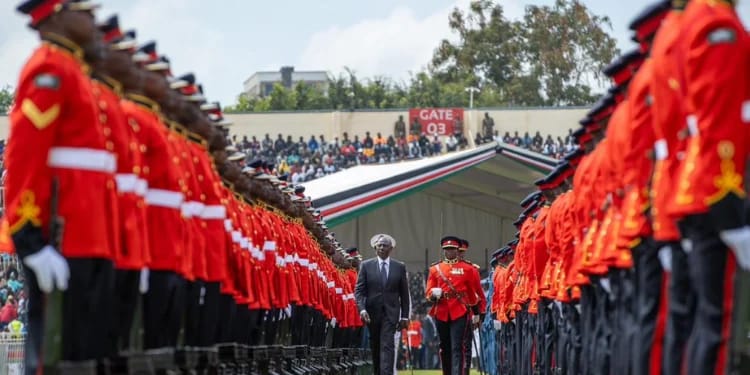
In his Jamhuri Day address at Nyayo Stadium, President William Ruto painted a vision of Kenya’s economic future, insisting that the policies guiding the country are not short-term experiments, but deliberate, long-term strategies designed to transform the nation from the ground up.
Addressing months of public debate over taxes, borrowing, public spending, and the sale of state enterprises, the President framed his administration’s approach as a conscious effort to tackle issues that previous governments had “postponed, tolerated or normalised.” He argued that economic stability could only be achieved by resetting systems at their very foundations.
At the heart of this transformation is the Bottom-Up Economic Transformation Agenda, which Ruto described not as a campaign slogan but as a blueprint for restructuring how the state interacts with citizens.
Farming the Future
Ruto highlighted agriculture as one of the clearest indicators of this shift. A national database now maps 7.2 million farmers, giving the government a detailed understanding of who produces food and what their needs are. Fertiliser subsidies, low-interest credit, and targeted extension services, he said, are finally reaching the intended beneficiaries.
“We lowered the cost of production, brought the price of fertilizer down, and in doing so, we restored profitability to the smallholder farmer who produces 70% of our food,” the President said, citing higher maize output, more stable unga prices, and the recovery of cash crops as evidence.
Education
Education reforms also featured prominently. Ruto noted the recruitment of 76,000 teachers, soon to reach 100,000, as part of an effort to rescue an overstretched sector. The new funding formula, guided by need and merit, has already benefited nearly half a million students.
“Nearly 500,000 students have already benefited from this funding model, students who under previous systems would have been excluded by policies that failed to recognize them,” he stated. New classrooms and laboratories are sprouting nationwide to reduce congestion and improve learning outcomes.
Health
On health, the President promised a “deliberate break from the past,” highlighting the registration of 28 million people under the Social Health Authority and the deployment of 110,000 Community Health Promoters. The unified digital health system now provides real-time visibility of patient care, while 2.3 million vulnerable households including widows, orphans, and the elderly have their healthcare costs fully covered.
“Healthcare was never meant to be a privilege, it is a right fully secured. And with the realization of this right, we are ready to walk with them into the next chapter of economic freedom,” Ruto said.
Housing
Ruto turned to housing, often a contested programme, noting the construction of 240,000 affordable units, student hostels for 180,000 learners, and institutional housing for security officers. The Sh650 billion pipeline has created over 480,000 jobs, integrated the Jua Kali sector into mainstream construction supply chains, and provided counties with long-overdue market infrastructure.
“Housing is an economic asset, not just a roof,” he said.
Youth Empowerment
The President emphasized youth programmes, reporting that two million young people have been trained in digital skills, nearly 300,000 are earning from online work, and almost half a million have found well-paying opportunities abroad through the Kazi Majuu initiative. The NYOTA Programme, capitalized at Sh20 billion, supports youth businesses with training and start-up capital.
Ruto also detailed financial reforms, noting that stronger NSSF contributions have doubled the fund’s reserves in two years. The Hustler Fund has disbursed over Sh80 billion, enabling seven million formerly blacklisted Kenyans to rebuild their credit history.
Infrastructure development took center stage. The President outlined plans to modernize roads, ports, railways, and airports through public-private partnerships. Key projects include the Nairobi–Nakuru–Mau Summit and Nairobi–Mai Mahiu–Naivasha roads, the Standard Gauge Railway extension from Naivasha to Malaba starting February 2026, and dualing 2,500 kilometres of highways alongside tarmacking 28,000 kilometres of roads.
“Charging forward, our infrastructure expansion will provide the foundation support for a strong, resilient economy that will drive transformative development for all,” he added.
Irrigation and food security
Ruto emphasized irrigation as critical to Kenya’s food system, announcing plans for 50 mega dams, 200 mini dams, and over 1,000 micro dams to bring 2.5 million acres under production.
On privatisation, Ruto reassured that the state would continue to open space for private investment where government is “the bottleneck,” emphasizing long-term concessions and partnerships for ports, airports, and logistics infrastructure.
Nairobi gets special attention
The President didn’t leave Nairobians empty-handed. In partnership with the county government, he announced major infrastructural projects beginning this December, including the reconstruction of the JKIA-ADC road and the dualing of key arteries such as the Bomas of Kenya–Kiserian route. Thika Super Highway will be upgraded to an expressway model.
“I know that there are a lot of people who reside outside Nairobi but work in Nairobi, and there’s a lot of traffic congestion in the morning and evening. Next year we’ll dual the Bomas of Kenya–Rongai–Kiserian, and the Bomas of Kenya–Karen–Ngong–Bulbul–Kiserian to ease congestion,” he said.
Upon request from Nairobi Governor Johnson Sakaja, Ruto also announced that the newly built Talanta Stadium will be renamed Raila Amolo Odinga International Stadium upon completion, with a full revamp including a canopy roof similar to Kasarani.
“I’ve heard what Governor Sakaja has said, that Talanta Stadium should be renamed to Raila Amolo Odinga International Stadium. I’ve heard you, and we’ll do that upon completion,” he confirmed.
Throughout his address, President Ruto maintained that these reforms spanning agriculture, education, health, housing, youth empowerment, finance, and infrastructure form a single trajectory: stabilizing the economy, expanding opportunity, and laying the foundation for what he called Kenya’s economic freedom.
“The choices have been difficult and often unpopular, but they are necessary for the country’s next chapter. The foundation is firm, and we are ready to charge forward full-steam,” he concluded.
