


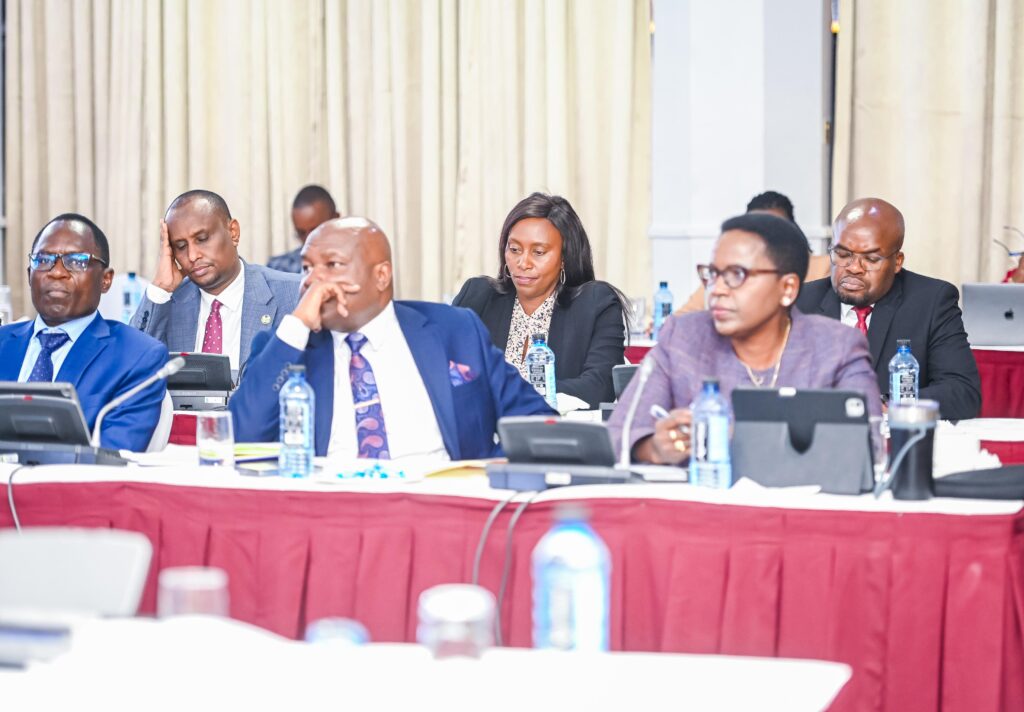
A new national scorecard has named Kenya’s highest-impact Principal Secretaries of 2025, laying bare who is delivering results and who is reshaping the country’s governance landscape through measurable performance.
Kenya’s top-performing Principal Secretaries for 2025 have been unveiled in a new national performance evaluation by Politrack Africa, offering the clearest snapshot yet of technocratic leadership within government ministries. The assessment, which reviewed all 51 PSs, draws on performance contracting data, budget absorption, project delivery, digital transformation, stakeholder engagement and statutory accountability to determine which state departments demonstrated the highest levels of efficiency and public impact over the past year.
At the top of the national ranking are Dr. Raymond Omollo, the Principal Secretary for Interior and National Administration, and Elijah Mwangi, the PS for Sports. The two tied with an impressive score of 69.7 percent, reflecting strong delivery of national programmes, improved service systems, and progress in digitising their respective departments’ operations. Their leadership is cited as emblematic of the administration’s push for a results-based public service.
Close behind them is Dr. Esther Thaara Muhoria, the PS for TVET, who secured a score of 67.2 percent. Politrack notes that her department saw significant reforms that boosted TVET enrollment, strengthened institutional capacity, and enhanced skills development across the country. The report also highlighted the performance of Charles Hinga, PS for Housing and Urban Development, whose role in advancing the Affordable Housing programme earned him a score of 65.5 percent, placing him among the highest contributors to national infrastructure priorities.
Also featured prominently is Amb. Prof. Julius Bitok, the PS for Basic Education, who scored 64.1 percent, reflecting gains in policy reforms and improvements in basic education outcomes. In the broader public administration sector, Dr. Jane Kere Imbunya, PS for Public Service and Human Development, scored 62.8 percent, credited for strengthening HR systems and improving processes that support government-wide staffing and performance management.
Infrastructure and energy, two pillars of Kenya’s economic agenda also produced high-ranking PSs. Eng. Joseph Mungai Mbugua, the PS for Roads, scored 61.5 percent, recognised for the acceleration of road construction and reforms aimed at improving contractor management. Meanwhile, Alex Wachira, PS for Energy, posted a 60.3 percent score following progress in electricity access, grid stabilisation and renewable energy integration.
Children’s services and economic initiatives also featured in the upper tier of the rankings. CPA Carren Ageng’o Achieng, PS for Children Welfare Services, scored 59.2 percent, while Abubakar Hassan, PS for Investment Promotion, followed closely with 58.1 percent, reflecting enhanced investor engagement and streamlined investment processes.
Public health reforms remained a major highlight in the evaluation. Mary Muthoni, the PS for Public Health and Professional Standards, earned a 57.1 percent score just days after her department received the prestigious SDG Award 2025 for integrating global health targets on malaria, tuberculosis, nutrition and preventive care. Politrack attributed her strong showing to improvements in disease prevention systems and health-sector coordination.

Agriculture, finance, culture and youth sectors were also well represented. Ephantus Kimotho, PS for Irrigation, scored 56.2 percent, recognised for driving irrigation expansion and water storage initiatives critical to food security. Dr. Chris Kiptoo, PS for the National Treasury, posted 55.4 percent, while Ummi Mohammed Bashir, PS for Culture and Heritage, scored 54.6 percent following renewed efforts to preserve cultural assets and support creative industries.
Tourism’s resurgence was reflected in the performance of John L. Ololtuaa, PS for Tourism, who earned 53.9 percent. Gender and youth portfolios also made notable appearances in the ranking, with Anne Wang’ombe, PS for Gender Affairs and Affirmative Action, scoring 53.2 percent, and Fikirini Kahindi Jacobs, PS for Youth Affairs, scoring 52.8 percent, each contributing to empowerment initiatives and national inclusion policies.
Higher education, social protection and public works rounded out the group of high-scoring technocrats. Beatrice Inyangala, PS for Higher Education and Research, scored 52.6 percent; Joseph Motari, PS for Social Protection, posted 52.5 percent for expanding social safety nets; and Joel Arumonyang, PS for Public Works, scored 52.4 percent, cited for improved infrastructure delivery systems. Also featured in the final band of the top performers is Aurelia Chepkirui Rono, PS for Parliamentary Affairs, with a 52.3 percent score.
Politrack Africa said the multi-pillar evaluation focusing on core mandate delivery, national impact, innovation and integrity provides a “national dashboard” of government performance and offers a framework for strengthening public-sector accountability. The findings, the organisation noted, will be submitted to Parliament, the Head of Public Service and the Office of the President to guide reforms and reinforce citizen-centered service delivery across ministries.
With the government preparing for the next phase of its Medium-Term Plan, the evaluation offers a clear indicator of where state departments are performing strongly and where gaps persist. Analysts say the results reflect a public service increasingly driven by data, measurable outputs and stronger internal governance, signalling a shift toward a more performance-based bureaucracy.
Politrack Africa evaluated all 51 Principal Secretaries using a rigorous system built around four pillars: how well they delivered on their core mandates (40%), their strategic leadership and national impact (30%), their innovation and digital reforms (15%), and their integrity and public accountability (15%). The assessment examined factors such as meeting performance targets, budget discipline, policy implementation, digitisation of services, anti-corruption measures, and citizen satisfaction.
The rankings were based on three evidence sources: official government performance and audit data (60%), qualitative submissions from PSs outlining their achievements (30%), and feedback from staff, partner agencies and the public (10%).
Politrack says the model rewards impact, innovation and ethical leadership, offering a national snapshot of how key government departments are performing. The findings set to be shared with Parliament, the Head of Public Service and the Presidencyare expected to inform reforms and resource allocation across ministries.
