


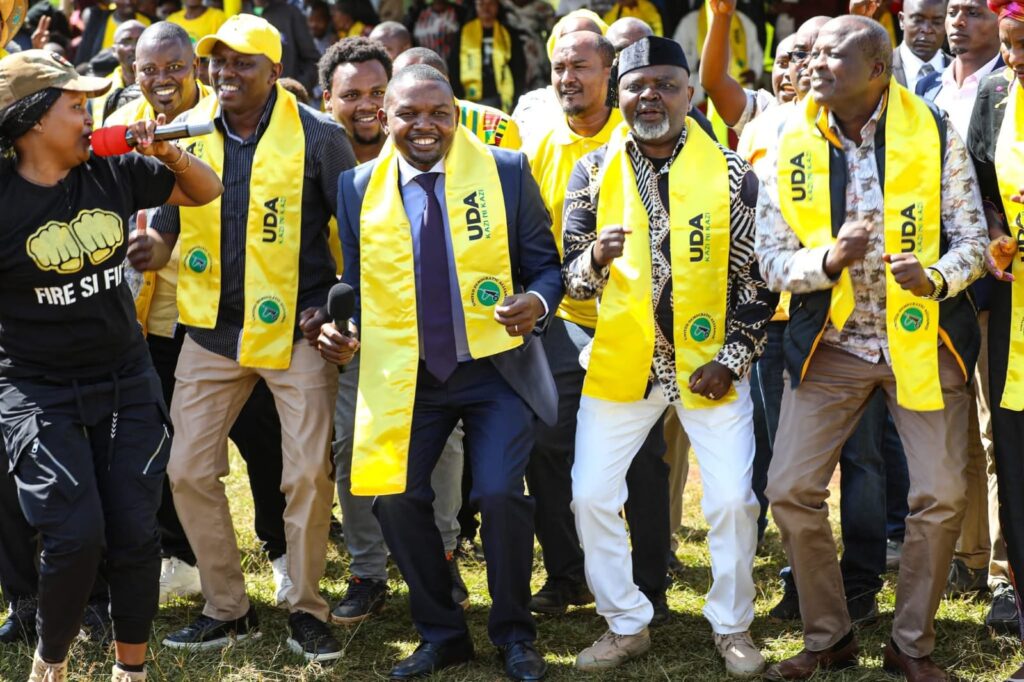
The United Democratic Alliance (UDA) has kicked off a closely watched internal contest for key national party positions, with the race for national chairmanship shaping up as a critical test of influence as the ruling party positions itself ahead of the 2027 General Election. The process is unfolding alongside grassroots elections, which party insiders say will significantly shape delegate alignments and the eventual balance of power at the national level.
Meru Senator and Senate Deputy Speaker Kathuri Murungi has now formally declared his intention to contest the UDA national chairmanship, stating that he is not seeking any other position within the party. Speaking on his bid, Murungi said the decision followed extensive consultations and long-held personal conviction, noting that Meru County remains a key political stakeholder within UDA. He argued that his experience and standing in the party qualify him for the top administrative seat.
“I am only interested in the position of UDA national chairman. This is something I have thought about deeply and consulted widely on. Meru is a key stakeholder in UDA, and I am qualified to serve at any level,” he said.
Murungi noted that the position will fall vacant ahead of the party elections scheduled for January 10, 2026. He pointed out that unlike the current chair, Embu Governor Cecily Mbarire, who was appointed, the next office holder will be elected by national delegates drawn from 20 counties, marking a shift toward a more participatory process.
Outlining his leadership priorities, Murungi said his focus would be on defending human rights and ensuring the government is held accountable in delivering on its manifesto commitments. On national politics, he cautioned against proposals to introduce additional principal assistants to President William Ruto, warning that such moves could deepen political divisions. He also called for unity within the Mount Kenya region and nationally.
“All Kenyans must work together to strengthen the party. We should support Deputy President Kithure Kindiki and avoid narratives that split Mount Kenya into East and West. Unity is critical,” he said.
The senator reiterated his support for President Ruto’s economic transformation agenda, arguing that Kenya must make deliberate sacrifices to attain first-world status. He cited Ethiopia as a rising regional competitor and called for increased investment in infrastructure and public amenities.
“We may be late, but we must make the necessary sacrifices to reach that level of development. I fully support the President’s efforts to grow Kenya’s economy to compete with countries like South Africa and Nigeria,” Murungi said.
Turning to agriculture, he described the sector as the backbone of Meru’s economy, citing progress in coffee and tea production but expressing concern over delays in fertilizer distribution despite early farmer registration. He urged timely procurement to boost yields and farmer incomes. Murungi added that dairy farmers stand to benefit once modern feed machinery at Meru Dairy becomes operational, noting that he has actively pushed for the commissioning of the Mitunguu dairy farmers’ factory.
On infrastructure, Murungi attributed delays in road projects across Meru to funding constraints, expressing optimism that construction would resume once the national government releases the required funds. He also criticised Meru County Commissioner Jacob Ouma, accusing him of failing to decisively address insecurity, citing recurring banditry incidents in Buuri, Igembe and Tigania areas as a major concern.
UDA’s current national chairperson, Embu Governor Cecily Mbarire, remains a central figure as party organs supervise ward and county-level elections across the country. These polls are widely viewed as a litmus test for loyalty and mobilisation strength, with emerging county leaders expected to influence delegate positions ahead of any changes at the top.
As competition quietly intensifies, the chairmanship race is increasingly being framed as a strategic positioning battle rather than an open confrontation. Political observers say the outcome will have far-reaching implications for UDA’s cohesion, its relations with coalition partners and its preparedness for future electoral contests, making the internal process one of the most consequential developments to watch in the months ahead.
