


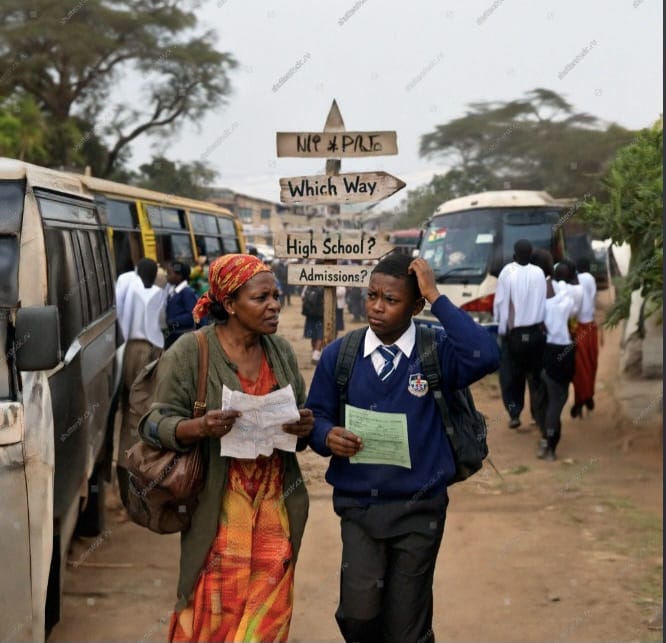
Concerns are mounting over the ongoing Grade 10 placement exercise, with parents and teachers raising red flags over what they describe as glaring inconsistencies that could undermine confidence in the transition to senior secondary school.
Among the issues flagged are cases where learners who scored very high marks in the Kenya Junior Secondary Education Assessment (KJSEA) have been placed in day secondary schools, while others have reportedly been assigned to institutions that do not match their gender. School heads have also complained of receiving admission lists without learners’ marks, making it difficult to assess the fairness of placements.
The concerns were raised by Meru South KNUT Branch Executive Secretary Albert Njeru Mutani, who warned that unresolved anomalies could erode trust in the placement process despite gains made under the Competency-Based Education (CBE) system.
Addressing journalists on Thursday, Mutani , who also serves as a KNUT National Trustee, urged the government and education stakeholders to reinforce support for the 100 per cent transition policy, noting that millions of learners are affected.

“Our children have successfully transitioned through all the levels, and the beauty of CBE is that it ensures 100 per cent progression,” Mutani said, noting that about 1.1 million learners sat the KJSEA examinations.
Parents have also voiced frustrations over placements that disrupt family logistics. Catherine Kimaita, a parent from Timau in Buuri Sub-County, said her son was placed in a day school in Igoji, South Imenti, several kilometres from home.
She admitted she was not adequately informed about the career-based pathways under the CBE system.
While supporting the policy in principle, Mutani warned that structural challenges could threaten its sustainability, citing delays in capitation disbursement, lack of school feeding programmes, and the rising cost of uniforms.
“Feeding programmes and timely release of capitation are critical. Without them, many children risk dropping out. Uniforms have also become a major burden for some families. In its programme planning, the government should consider providing them in the future,” he said.
On placement procedures, Mutani reminded parents that official admission letters can only be accessed through the Ministry of Education placement portal, advising those seeking transfers to visit the respective schools for principals to update the system.
“Do not buy school supplies before your child is officially admitted and captured in the system, as it might end up being a loss to you,” he cautioned.
He appealed to financial institutions, county governments, community-based organisations and well-wishers to support learners transitioning to Grade 10, noting that many high-performing students come from vulnerable backgrounds.
Mutani also urged school principals to show flexibility by allowing friendly fee payment plans to ease the burden on struggling families.
Despite the concerns, he reassured parents that there was no cause for panic, saying the system has sufficient capacity to absorb all learners.
He, however, flagged a shortage of senior secondary school teachers, warning it could affect learning outcomes if not urgently addressed.
At the same time, Mutani commended the Kenya Kwanza administration for employing 76,000 Junior Secondary School teachers and for releasing capitation funds ahead of school reopening.
