


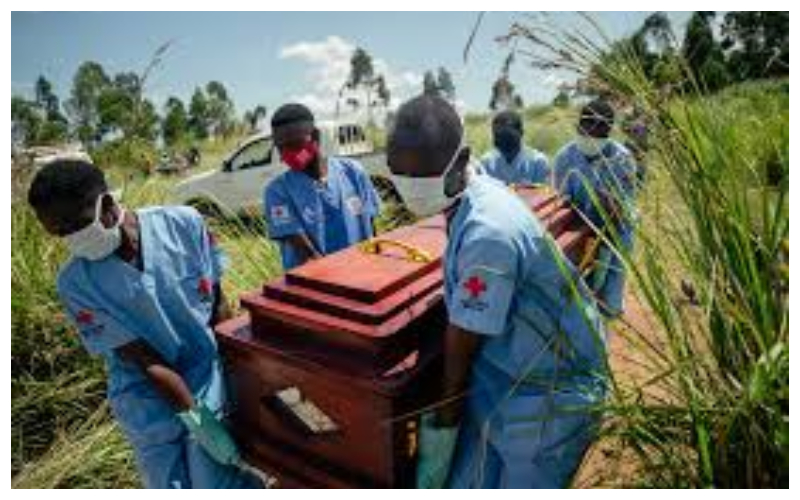
Members of a Congolese Red Cross team carry the coffin of a woman suspected of having died from Ebola virus disease during her safe burial at a cemetery in Bunia on June 7, 2026.
Jospin Mwisha/AFP
The Africa Centres for Disease Control and Prevention (Africa CDC) has raised alarm over major gaps in contact tracing, surveillance and funding, warning that the ongoing Ebola outbreak in the Democratic Republic of Congo (DRC) and Uganda could worsen without urgent intervention.
Speaking during the agency’s weekly Ebola situation briefing, Africa CDC Director General Dr. Jean Kaseya said the outbreak has continued to spread rapidly since it was officially declared on May 15, 2023.
Outbreak numbers continue to rise
The current outbreak, caused by the Bundibugyo strain of the Ebola virus, has become one of the most serious Ebola crises in recent years. As of 24 September 2023, more than 635 confirmed cases and 127 deaths had been reported in the DRC, while neighbouring Uganda had identified more than 60,000 contacts linked to the outbreak.
The epicentre remains Ituri Province, which accounts for more than 90 per cent of confirmed cases and nearly three-quarters of all deaths.
Contact tracing gaps raise concern
Dr. Kaseya said the response is struggling to keep pace with the outbreak because of weak surveillance systems and inadequate contact tracing in affected areas.
“One confirmed Ebola case should generate about 40 contacts that should be monitored. At present, we have over 6,022 contacts on our list, but based on the number of confirmed cases we should be tracking close to 24,000 contacts,” he said.
He described the low number of identified contacts as a major warning sign.
“There are still low contact lists in Ituri and North Kivu and even among those identified the monitoring is inadequate. We are working at 17 to 30 per cent of the expected coverage. If we don’t identify and monitor these people, we’re at a high risk of transmission in the communities,” Dr. Kaseya added.
Africa CDC estimates that only about 57 per cent of identified contacts are currently under active follow-up, far below the 90 per cent coverage health experts say is needed to effectively contain Ebola transmission.
Insecurity and mistrust slowing response
Dr. Kaseya attributed the challenges partly to insecurity in affected communities and a lack of public trust.
“We do not have control over the outbreak because we still have people who are infected and not getting treatment,” he said.
He noted that tracing contacts has been especially difficult in the hardest-hit areas and appealed to local authorities to support health workers and emergency teams.
“We are asking countries and local authorities in affected areas to help us and make access easier. We are in a climate of mistrust, insecurity and limited resources,” he said.
Funding shortfall threatens response efforts
The Africa CDC chief also expressed concern about insufficient financing for the outbreak response.
This week, the European Union announced an additional €11.5 million in support, bringing its total contribution to about €18 million. However, health agencies say substantially more funding is required to contain the outbreak and strengthen regional preparedness.
Earlier this month, Africa CDC and the World Health Organization (WHO) launched a continental preparedness and response plan seeking US$518 million for outbreak control, surveillance, laboratory capacity and border preparedness across Africa. So far, the initiative has received about US$212 million.
Multiple outbreaks straining health systems
Dr. Kaseya warned that Ebola is not the only public health emergency confronting African countries.
“Today Africa is not only dealing with Ebola. We are also dealing with Cholera, Mpox and Measles outbreaks in several countries,” he said. “We want to reduce outbreaks all across the region.”
He stressed the need to build stronger and more resilient health systems capable of responding to multiple infectious disease threats simultaneously.
“If we can build resilience in countries, not only to prevent Ebola but also other outbreaks like measles we can save many lives,” he said.
While vaccines are available for measles, he noted that uptake remains low, underscoring the need to strengthen routine immunization and public health systems.
Young people and children heavily affected
The outbreak has largely affected people aged 15 to 44 years, but health officials say the highest burden of illness has been recorded among children aged zero to four years.
No broad travel restrictions for now
Although medical experts remain concerned about the possibility of international spread, Dr. Kaseya said there is currently no evidence requiring broad travel restrictions on unaffected areas.
“The priority right now is finding contacts, monitoring them and getting those infected people treated as soon as possible. That is how we stop transmission,” he said.
Health officials warn that without improved surveillance and additional funding, the current outbreak could become one of the largest Ebola epidemics in Africa. Africa CDC says it currently ranks third among the 21 Ebola outbreaks recorded on the continent.
African heads of state are expected to meet next Tuesday for an emergency summit focused on coordinating the regional response and strengthening Ebola management efforts.
