


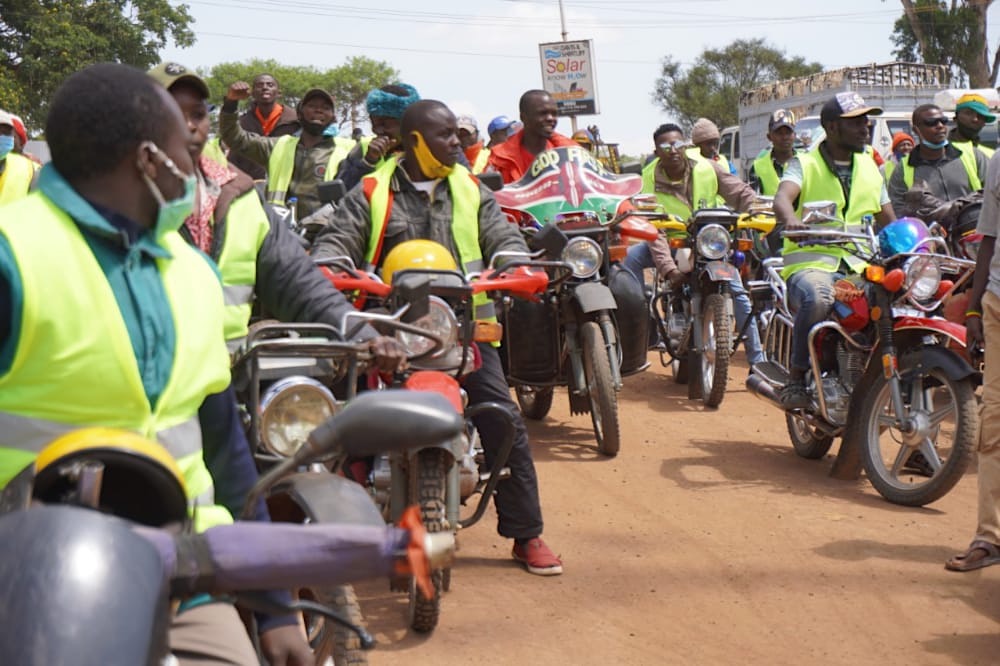
Boda boda operators from Kenya and Uganda have joined forces with security agencies and financiers to form a special cross-border committee aimed at curbing the growing wave of motorcycle theft that has been crippling riders’ livelihoods.
The joint task team, bringing together police officers, boda boda leaders and asset financiers, will focus on intelligence sharing and coordinated operations to track and recover stolen motorcycles often smuggled across the porous Kenya–Uganda border.
The resolution was reached during a high-level security meeting held at the Suam border point in Endebess, Trans Nzoia County, convened by motorcycle financier Mogo in partnership with the Boda Boda Safety Association of Kenya (BAK).
Stakeholders revealed that criminal networks have become increasingly sophisticated, with suspects using multiple number plates from both countries and altering chassis numbers to evade detection.
“Once these motorcycles cross the border, they are quickly given new identities, making recovery extremely difficult,” said one participant during the forum.
Riders also pointed to unlicensed scrap metal dealers as a critical link in the theft chain, accusing them of buying dismantled parts and sustaining the illegal trade.
On the Ugandan side, the scale of the problem is equally alarming. Sebei Sub-region Chairman Chekwoti Ahmed said over 200 registered motorcycles have been stolen in the past two years alone.
“Some of these stolen bikes are believed to have crossed into Kenya, particularly in Kapenguria and Endebess,” he said.
Recent successes have, however, shown the power of collaboration. Two motorcycles stolen from Nandi County were recovered in Uganda following joint efforts by security teams and boda boda operators.
Security officials are now urging riders to be more vigilant. Acting Officer Commanding Suam Police Station in Uganda, Sgt Topacho Ronald, warned that criminals often pose as customers.
“Be cautious of passengers who pressure you to speed at border points. That is one of the tricks used to evade checks,” he said.
His Kenyan counterpart, Eric Mutua, emphasized the need for due diligence when purchasing second-hand motorcycles and called for immediate reporting of suspicious activities.
“We must also confront corruption at border points, where some suspects bribe their way through with stolen motorcycles,” Mutua added.
BAK Chairman Kevin Mubadi underscored the importance of timely information sharing, noting that faster communication between riders and authorities could significantly reduce losses.
Meanwhile, Mogo Kenya’s Deputy Country Manager, Branton Mutea, said the initiative will protect riders who depend on financed motorcycles for survival.
“This collaboration is critical in safeguarding the economic backbone of thousands of young people,” he said.
To strengthen the fight against theft, stakeholders proposed a raft of measures, including formal registration of boda boda stages, unique identification systems for riders, installation of tracking devices, and tighter surveillance of smuggling corridors commonly known as “panya routes.”
They also called for stricter enforcement against illegal scrap dealers and deeper cooperation between Kenyan and Ugandan authorities.
As cross-border crime evolves, the newly formed committee is expected to serve as a crucial frontline defense protecting not just motorcycles, but the livelihoods they sustain.
