


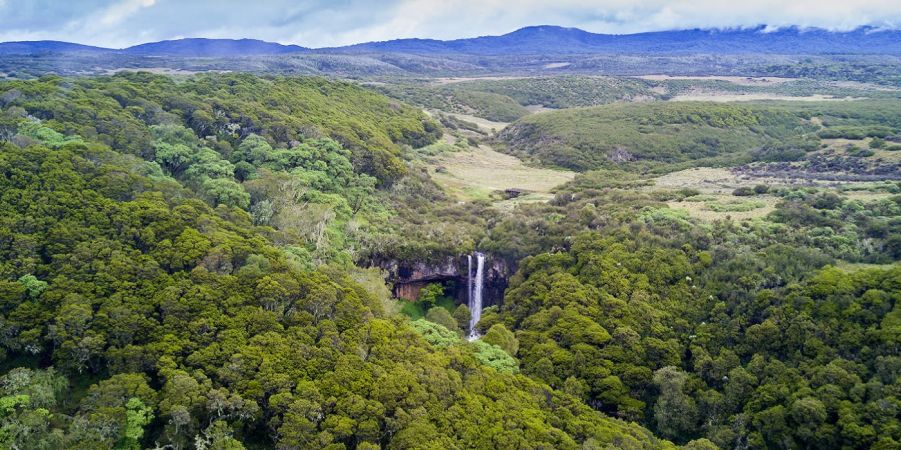
Residents in Ndaragwa, Nyandarua County, have been urged to step up efforts to protect the Ndaragwa Forest, the Aberdare Forest, and Lake Ol-Bolossat from increasing threats of degradation, encroachment, and illegal farming.
The ecosystems, classified as key water towers, are under pressure from declining water levels, with Lake Ol-Bolossat reportedly losing more than 68 per cent of its hydro-area. Environmental officials warn that the trend is undermining the region’s ecological balance and threatening downstream water supply systems.
Speaking during a tree-planting exercise in Muruai area, Ndaragwa Constituency, the Secretary for Conservation in the State Department for Wildlife, Dr. John Chumo, said coordinated interventions were underway to restore and conserve the interconnected ecosystems.
Dr. Chumo, who represented the Principal Secretary at the event, said the Aberdare ecosystem remains a critical catchment area feeding Lake Ol-Bolossat, which in turn sustains the Ewaso Nyiro River system.
He noted that the river traverses at least seven counties ;Nyandarua, Laikipia, Samburu, Isiolo, Marsabit, Wajir, and Garissa before tdraining in the Lorian Swamp, underscoring the far-reaching importance of protecting upstream water sources.
“The conservation of the Aberdare and Ndaragwa ecosystems is not just a local matter but a national priority because of the communities and counties that depend on this water system downstream,” Dr. Chumo said, emphasizing the need for sustained protection of the water tower.
During the exercise, 10,000 indigenous tree seedlings were planted as part of ongoing efforts to restore degraded forest areas and strengthen ecological resilience within the region.
Dr. Chumo further noted that multiple stakeholders—including government agencies, religious institutions, corporate partners, and local communities—had come together to support conservation initiatives.
He stressed that long-term success would depend on collective responsibility, saying environmental protection must move beyond government programmes to community-driven action.
“Deliberate efforts are being undertaken to conserve these ecosystems, but this can only be sustained if all stakeholders take ownership of conservation initiatives,” he said, adding that partnerships remain key in restoring forest cover and protecting water catchment areas.
At the same event, Ndaragwa Forest Station Manager David Mucheru raised concern over the extent of degradation within parts of the forest, estimating that about 500 hectares require urgent restoration.
Mucheru called for increased support from local communities to help rehabilitate the affected areas and prevent further environmental loss.
“It is necessary to expand forest cover and strengthen ecological resilience within the Aberdare ecosystem,” he said, while appreciating the State Department for Wildlife for supporting restoration efforts through the donation of indigenous tree seedlings.
He added that the ongoing restoration initiatives are aimed at reversing deforestation trends and ensuring the long-term sustainability of both forest and water resources in the region.
Environmental stakeholders say the coordinated planting exercise marks a growing commitment to restoring Kenya’s critical water towers, even as pressure from human activity continues to threaten fragile ecosystems.
The Aberdare ecosystem remains one of Kenya’s most important water catchment zones, supporting agriculture, biodiversity, and domestic water supply across multiple counties.
