


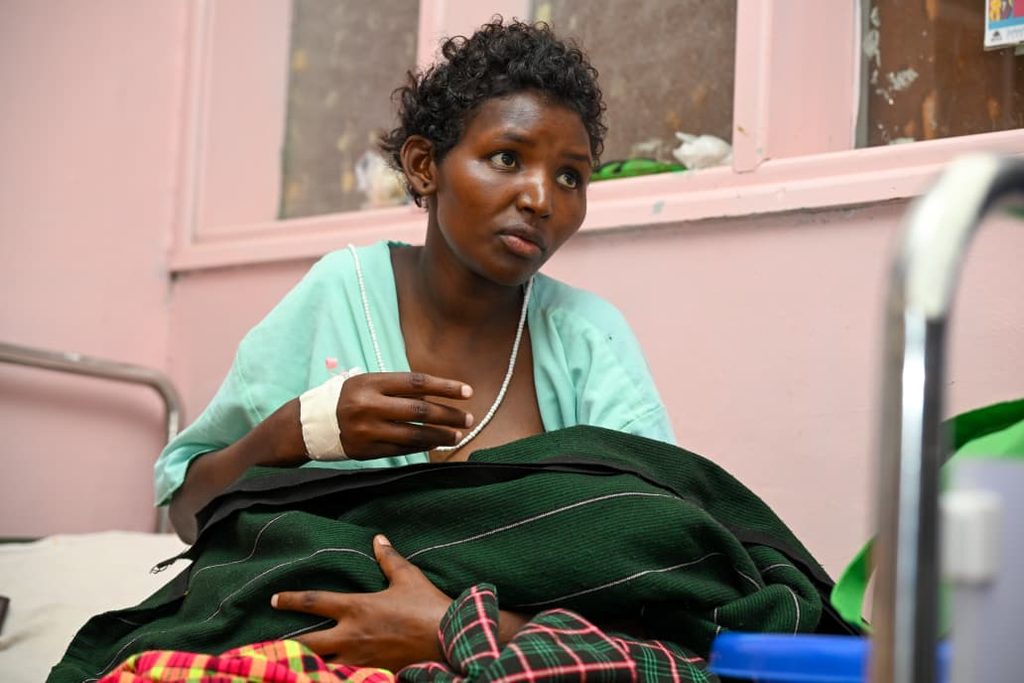
At Samburu County Referral Hospital in Maralal, Naitaman Netamula is learning to enjoy a moment she once feared might never come.
By Norah Ireri
Her three-day-old daughter lies close to her, suckling quietly as the 25-year-old watches over her. It is an ordinary scene in a maternity ward, but for Netamula, it represents the end of a long and painful wait.
She has lost six pregnancies. Her marriage collapsed under the weight of childlessness, and the prospect of becoming a mother had gradually become something she was afraid to hope for.
“I had given up on ever having a child,” she says, her voice carrying the weight of those years.
In her community, she says, motherhood is closely tied to a woman’s sense of belonging and social acceptance. The inability to have a child left her feeling isolated, while her husband eventually walked away.
“I have a condition that stopped me from bearing children, and without a child in my community I am useless,” she says.
Netamula later learnt that she had a Rhesus-negative blood type. The condition can complicate pregnancy when a Rhesus-negative woman carries a Rhesus-positive baby. If the mother’s immune system becomes sensitised, it may produce antibodies that attack the baby’s red blood cells, potentially causing severe anaemia, jaundice and other life-threatening complications.
“Losing six children is not easy. I was an outcast,” she says.
When she became pregnant again, unexpectedly and outside marriage, she decided to seek help early. Having heard accounts of women who had benefited from the maternal shelter at Samburu County Referral Hospital, she made the journey from Kisima, about 21 kilometres away, to Maralal.
At four months, doctors identified complications associated with her Rhesus status and admitted her for close monitoring. She remained under care until she delivered.
For women like Netamula, the shelter offers more than a place to sleep. It brings expectant mothers with complicated pregnancies closer to health workers, allowing them to be monitored and receive timely intervention should their conditions deteriorate.
Rhesus incompatibility can be prevented in many cases through Anti-D immunoglobulin, an injection given to eligible Rhesus-negative women before they develop antibodies. It is usually administered during pregnancy and, where indicated, after delivery if the baby is Rhesus positive. Antenatal screening is essential because once sensitisation has occurred, Anti-D cannot reverse it.
Netamula’s experience reflects the wider challenge facing maternal healthcare in Samburu, where distance, difficult terrain and delays in reaching hospitals can place pregnant women and newborns at risk.
The county’s landscape is marked by open plains, rugged hills and widely scattered settlements. Its three sub-counties — Samburu Central, Samburu East and Samburu North — cover communities whose access to specialised medical services varies considerably.
Maralal, the county headquarters, hosts Samburu County Referral Hospital, the main referral facility. But for women living far from the town, reaching it can be a difficult undertaking, particularly when pregnancy complications require urgent attention.
Dr Nassir Lekudere, Samburu County Executive Committee Member for Medical Services, Public Health and Sanitation, says the county has expanded its capacity to respond to maternal and newborn emergencies.
“In every of our three sub-counties we have operation theatres to curb maternal and neonatal deaths,” he says.
The county has also invested in community-level mobilisation, using Community Health Promoters to encourage expectant mothers to attend antenatal clinics and deliver in health facilities.
“We have trained our Community Health Promoters (CHPs) on maternal health care and to mobilize the mothers to utilize the ante Natal Services and also to deliver in the hospital. We have several community units, The CHPs link the facilities with the community,” Dr Nassir says.
Access to blood is another critical part of emergency maternal care, particularly for women who develop severe anaemia or experience excessive bleeding during pregnancy or after childbirth.
Dr Nassir says the county has a blood satellite unit supported jointly by the national and county governments.
“This helps us address issues like severe anaemia, loss of blood, either during pregnancy or after delivery,” he says.
The maternal shelter, he adds, is intended for women whose previous pregnancy experiences or current conditions place them at increased risk.
“This maternal shelter helps us admit women at risk with a history of bad obstetric histories,” he says.
However, infrastructure alone cannot remove all the barriers. Dr Nassir identifies delayed referrals, poor road networks and unreliable electricity as persistent challenges.
“We have also had a challenge in erratic power supply from Kenya power,” he says.
To minimise disruptions, the county has installed automatic generators to supplement its solar system, helping maintain electricity in critical areas such as the neonatal unit and operating theatres.
The need for closer monitoring is particularly evident among younger mothers. Visiting obstetrician-gynaecologist Dr Funkupi Abdala, from Kwale County, is part of a medical team deployed to Samburu through the Council of Governors.
He says teenage pregnancy remains a significant concern, with stigma, limited awareness and dependence on parents sometimes preventing young women from seeking antenatal care.
“Early or teen pregnancy is very high in this area and we know some of the causes are anaemia, because some of them do not know how to take care of themselves very well. Also, for them to attend Antenatal clinic for them is a problem because they have to seek permission from their parents. They also do not know the significance of them attending the clinics,” he says.
The stigma surrounding teenage pregnancy further compounds the problem.
“The stigma is also high so they do not understand the significance of attending clinics,” Dr Abdala adds.
He says young mothers may face complications including pre-eclampsia, urinary tract infections and obstructed labour. In some teenage pregnancies, an underdeveloped pelvis may contribute to cephalopelvic disproportion, a condition in which the baby’s head or body cannot safely pass through the mother’s pelvis.
“There is a higher chance of obstructive labour in teenage pregnancies, the pelvis is not very well developed for these young mothers, which can lead to CPD — that is cephalopelvic disproportion,” he says.
Dr Abdala urges pregnant teenagers to attend antenatal clinics consistently and undergo additional monitoring where their individual circumstances require it.
Inside the shelter, the women are not only confronting medical risks but also the practical difficulties of managing pregnancy at home.
Twenty-five-year-old Eunice Lekishorumongi is among those admitted. Her first pregnancy was high-risk, and when she became pregnant again, she was determined to avoid another difficult experience.
“I was struggling to carry this pregnancy to term, I had lower abdomen issues,” she says.
Her husband was initially reluctant about her admission, but after seeing her condition improve during her two-month stay, he acknowledges the care she has received.
“The doctors here have helped her a lot,” he says.
For 37-year-old Esther Wagaitheri, carrying twins has brought its own anxieties. She has three children at home and says the demands of household responsibilities made it difficult to rest during the pregnancy.
At 38 weeks, after spending four weeks at the shelter, she is waiting for her twins to arrive.
“At home my situation was horrible, my pressure would rise and fall because of the strain I had to endure, I thought I would die. The pain was unbearable. At least here at the shelter I am closely monitored. They check on my swelling legs. They advise, they talk to me they manage the pressure and I feel better,” she says.
She has also found relief in being able to concentrate on her health and nutrition.
“You see, at home not everyone even gets the time or the food to eat. I know my family is okay but at least here I do not have to sacrifice the small food we have at home to feed for two!” she says, laughing.
Another expectant mother, Olis, has experienced three pregnancy losses. She has been at the shelter for two weeks and says the regular monitoring has given her renewed confidence.
“I have been here for two weeks; the doctors have been monitoring me and the pregnancy. So far, so good they say, I am ok. We are okay,” she says.
The shelter operates within the broader Every Woman, Every Newborn, Everywhere (EWENE) initiative, which seeks to ensure women and newborns receive essential care and that preventable deaths are reduced.
Samburu’s reported teenage pregnancy rate stands at 15 per cent, compared with the national figure of 11.9 per cent. The figures point to the continuing need for accessible antenatal services, early identification of complications and support for young mothers.
The maternal shelter is not a substitute for better roads, timely referrals or stronger health facilities across the county. But it provides an important link between women at risk and the care they may otherwise struggle to access in time.
For Netamula, its impact is deeply personal. After six pregnancies ended in loss, she now has a daughter to hold.
This time, she is not leaving the hospital with another painful memory. She is leaving with the child she had almost stopped believing she would ever have.
