


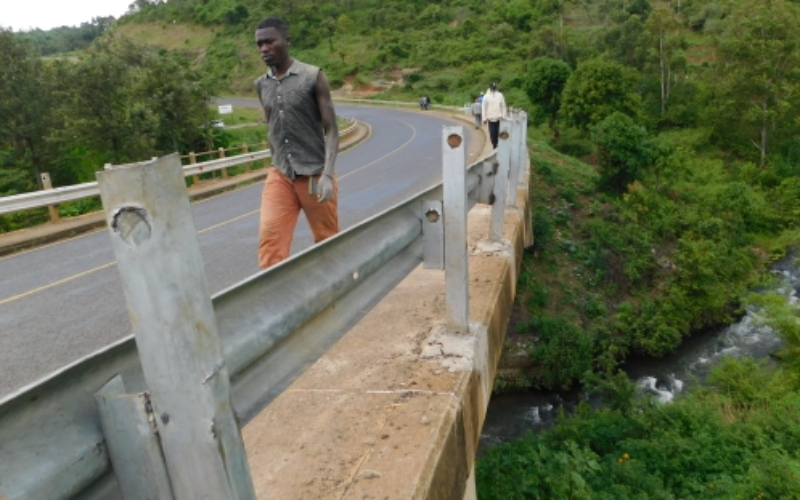
For decades, motorists approaching the dreaded Nithi Bridge along the Nairobi–Meru highway have instinctively lowered their voices, tightened their seat belts and whispered silent prayers.
Now, after years of fatal crashes, public outrage and unfulfilled political promises, residents of Tharaka Nithi County are finally beginning to see what many describe as “light at the end of the tunnel” as the government moves to construct a completely new and safer Nithi Bridge alignment.
The long-awaited breakthrough entered a crucial phase this week after officials from the Kenya National Highways Authority (KeNHA) and the National Land Commission (NLC) launched public sensitization and compensation processes for affected landowners ahead of construction works.
The project, being implemented under President William Ruto’s administration, is expected to permanently eliminate the deadly curves and steep descent that have turned Nithi Bridge into one of Kenya’s most feared road black spots.
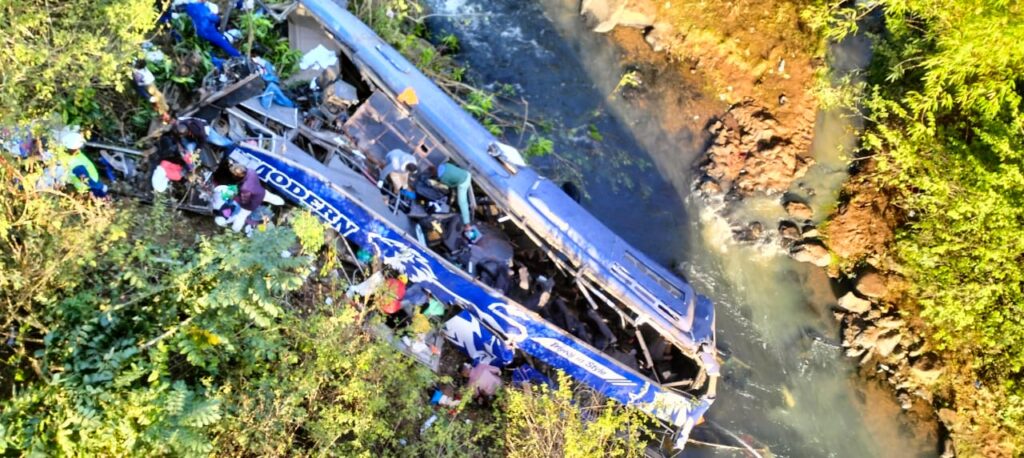
Wreckage of the Modern Coast Meru-Mombasa bound Bus that plunged into River Nithi on Sunday killing 34 people and 11 others with serious injuries.
For residents who have lived under the shadow of the bridge’s deadly history, the latest developments represent far more than an infrastructure project they symbolize the possible end of a national nightmare.
Since the Meru–Embu road section was commissioned in 1985, Nithi Bridge has become synonymous with horror, grief and loss.
The bridge’s steep gradient, winding contours and sharp blind curves have repeatedly been blamed for fatal accidents involving buses, lorries, miraa vehicles and private cars.
The deadliest accident occurred on August 25, 2000, when a Tawfiq bus travelling from Maua to Mombasa plunged into River Nithi, killing at least 45 passengers and injuring dozens more in one of Kenya’s worst road disasters.
At the time, international media reported that the crash pushed the number of people killed at the bridge to at least 158 within only five years.
Yet even after that catastrophe, the killings never stopped.
In 2022, another tragedy shocked the country when a Modern Coast bus veered off the bridge and plunged nearly 40 metres into the river, killing at least 33 people and injuring many others.
In August 2024, 12 more people died after a van collided head-on with a pickup truck at the same black spot.
Smaller but equally painful accidents have continued almost yearly, involving matatus, fire engines, miraa trucks and personal vehicles.
Over time, the bridge acquired chilling nicknames among travellers — “killer bridge,” “bridge of death,” and “the valley of no return.”
For many families in Meru, Embu and Tharaka Nithi, Nithi Bridge became a place associated with funeral announcements, overturned buses and emergency sirens.
The danger posed by the bridge has been discussed by politicians for years.
Successive leaders repeatedly promised redesigns, bypasses and engineering interventions, but little changed on the ground.
Former leaders and transport officials publicly acknowledged the danger, while local politicians frequently revisited the issue after every major tragedy.
In 2018, Tharaka Nithi Governor Muthomi Njuki proposed rerouting the road and constructing elevated pillars to avoid the dangerous slope.
In 2023, then Roads and Transport Cabinet Secretary Kipchumba Murkomen announced plans to straighten the road and redesign the bridge, but implementation remained slow.
Even after the 2024 crash that killed 12 people, then Deputy President Rigathi Gachagua admitted public frustration was mounting as families demanded answers over repeated deaths at the bridge.
For residents, every new promise increasingly sounded like a familiar political script repeated after tragedy struck.
But unlike previous years, heavy government activity is now visible on the ground.
On Monday, government officials held a major public sensitization forum at Muthambi Deputy County Commissioner’s hall, formally issuing gazette notices and beginning the land acquisition process for the new bridge alignment.
KeNHA Deputy Director in charge of Structures Engineer Michael Ngala said the new bridge will measure approximately 880 metres in length and about 100 metres in height, making it one of the region’s largest infrastructure projects.
Most importantly, the redesign will completely eliminate the dangerous curves and steep descent blamed for decades of fatalities.
“Today we have come for public sensitization and issuance of the gazette notice by the National Land Commission for the acquisition of land that will be used for the construction of the new realignment of Nithi Bridge,” said Ngala.
“The alignment basically means we are creating a safer route and acquiring land that will allow us to undertake safe construction and completely eliminate the curves that have been killing people for a long time,” he added.
Ngala confirmed that a contractor is already on site and preliminary works have begun.
The National Land Commission revealed that 81 parcels of land have been identified for compensation as the State prepares for full implementation.
NLC Director of Valuation and Taxation Joel Ombati said the project is aimed at serving public interest by improving road safety along one of Kenya’s busiest transport corridors.
“We are here to inform and allow the community to participate in relation to the acquisition of their land to ensure success in the construction of the bridge and associated facilities,” said Ombati.
Senior Valuer Elizabeth Makau assured residents that compensation would be conducted transparently and fairly, with field valuation set to begin.
County Commissioner David Gitonga urged families to cooperate with authorities and complete succession and land ownership documentation to avoid delays in compensation.
Among residents, the project has sparked cautious optimism.
For years, communities living near the bridge have watched rescue operations unfold repeatedly below the valley, bodies retrieved from wreckage, ambulances racing uphill and families gathering in tears after phone calls announcing tragedy.
Now many believe the suffering may finally come to an end.
Jane Gitari, a resident, said the project has renewed hope among families who have lost loved ones along the notorious stretch.
Residents say the planned realignment could transform not only road safety but also the psychological burden long associated with travelling through Nithi.
For decades, Nithi Bridge represented a place where journeys suddenly ended.
Today, as valuation teams begin work and construction plans move forward, many in Tharaka Nithi believe the country may finally be witnessing the beginning of the end of one of Kenya’s deadliest road nightmares.
